It’s the day after Thanksgiving. Millions of shoppers face a big choice. Should they go to crowded stores for Black Friday deals? Or should they wait until Monday to shop from home?
The Black Friday versus Cyber Monday debate is important. Savvy shoppers want to save money. Billions of dollars are on the line. Deals appear online and in stores. Knowing which day has the best bargains is key. It can mean getting great deals or missing out.
Shopping has changed a lot. It used to be simple. You could choose between Black Friday crowds or Cyber Monday online shopping. Now, it’s more complex. There are many deals and discounts. Strategic shopping is important.
Both days offer good reasons to shop. But they suit different shoppers. They also offer different products and savings.
Important points
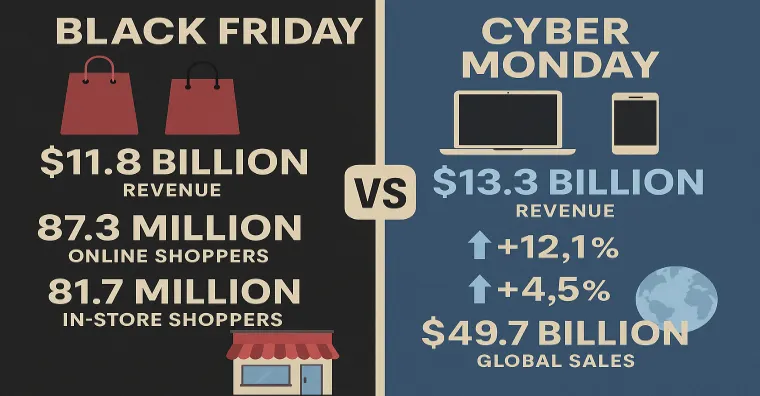
- Black Friday generated $11.8 billion in online U.S. sales in 2024, while Cyber Monday reached a record $13.3 billion, making it the biggest single sales day of the year [1] [2].
- 81.7 million consumers shopped in physical stores on Black Friday, compared to 87.3 million who shopped online, showing the continued importance of in-store experiences [1].
- Cyber Monday is projected to grow 6.3% to reach $14.2 billion in 2025, indicating continued momentum for online shopping [1].
- Product categories differ significantly between the two days, with Black Friday excelling in cosmetics and clothing, while Cyber Monday dominates in electronics and tech gadgets [2].
- 80% of all planned holiday gift spending occurs by the end of Cyber Monday, making the Cyber Five weekend crucial for completing holiday shopping lists [1].
Understanding the Black Friday vs. Cyber Monday Phenomenon
The Origins and Evolution of Both Shopping Days
Black Friday’s origin story is actually a trio of theories. The most widely cited account traces the name to 1960s Philadelphia, where police used the term to describe the chaotic crowds and gridlocked traffic that descended on the city the day after Thanksgiving.
A second theory points to the Army-Navy football game held the Saturday after Thanksgiving in Philadelphia, which drew such enormous crowds that the entire post-Thanksgiving weekend became associated with mayhem.
Retailers later popularized a third, more optimistic explanation: that the day represented the moment their accounting books moved from “red” (losses) to “black” (profits). This traditional shopping day has been the unofficial start of the holiday shopping season for decades.
Cyber Monday is a relatively invention. Created in 2005 by the National Retail Federation, it encouraged people to shop online. The timing was strategic; many people returned to work after the Thanksgiving holiday and used their high-speed office internet connections to complete their holiday shopping. 🖥️
Today’s reality is far more nuanced. Both days have expanded beyond their original 24-hour windows. Black Friday now starts on Thanksgiving Thursday (and sometimes earlier), while Cyber Monday deals often extend throughout Cyber Week. The lines between these shopping events have blurred considerably, creating what retail experts call the “Cyber Five” period spanning from Thanksgiving through Cyber Monday.
The Current State of Holiday Shopping in 2026
The shopping behavior in 2025 reflects a hybrid approach. According to recent data, Black Friday attracted 36% of consumers planning to shop, compared to 34% for Cyber Monday [1]. This nearly equal split shows that both days have established themselves as essential shopping events.
The Cyber Five weekend in 2024 attracted approximately 197 million shoppers, representing a massive portion of American consumers [1]. This five-day shopping marathon has become the most critical period for retailers, with Cyber Week sales in the U.S. reaching $76 billion, representing a 7% increase year-over-year [1].
What’s interesting is the channel preference shift. While Black Friday remains the most popular day for in-store shopping, with 81.7 million consumers visiting physical locations, online shopping has become equally important. Black Friday online shopping reached 87.3 million consumers, surpassing many industries expectations [1].
Black Friday vs. Cyber Monday: Sales Numbers and Statistics
Breaking Down the Revenue Records
The numbers tell an interesting story about the Black Friday versus Cyber Monday competition. Let’s examine the hard data:
Black Friday 2024 Performance:
- Online U.S. sales: $11.8 billion [2]
- Peak sales rate: $5.1 million per minute [2]
- In-store shoppers: 81.7 million [1]
- Online shoppers: 87.3 million [1]
Cyber Monday 2024 Performance:
- U.S. online sales: $13.3 billion (Adobe data) [1]
- Alternative report: $12.8 billion (Salesforce data, up 3% year-over-year) [1]
- Global sales: $49.7 billion (up 2% year-over-year ) [1]
- Projected 2025 growth: 6.3% to reach $14.2 billion [1]
| Metric | Black Friday | Cyber Monday | Winner |
|---|---|---|---|
| U.S. Online Sales | $11.8 billion | $13.3 billion | Cyber Monday 📱 |
| In-Store Traffic | 81.7 million | Minimal | Black Friday 🏪 |
| Online Shoppers | 87.3 million | Not specified | Data varies |
| Peak Sales Rate | $5.1 million/minute | Not specified | Black Friday ⚡ |
| Global Reach | U.S. focused | $49.7 billion | Cyber Monday 🌍 |
Understanding the Growth Trajectory
Cyber Monday has consistently shown stronger growth in recent years. The 6.3% projected growth for 2025 suggests that online shopping continues to gain momentum [1]. This growth isn’t just about convenience; it reflects changing consumer preferences, improved mobile shopping experiences, and the expansion of same-day or next-day delivery options.
However, Black Friday’s $5.1 million per minute peak sales rate shows the intense, concentrated buying power that occurs during this shopping event [2]. The urgency and excitement surrounding Black Friday create a unique shopping frenzy that Cyber Monday, despite higher total sales, doesn’t quite replicate.
“By the end of Cyber Monday, 80% of all planned holiday gift spending occurs, making this five-day period absolutely critical for both retailers and consumers looking to maximize their savings.” [1]
Product Categories: Where Each Day Shines
Black Friday’s Strongest Categories
Black Friday has traditionally excelled in specific product categories that benefit from in-store experiences and immediate gratification. The top-performing categories include:
Cosmetics and Beauty Products 💄
Black Friday has become the premier shopping day for beauty enthusiasts. Major retailers like Sephora, Ulta, and department stores offer exclusive gift sets, limited-edition products, and significant discounts on premium brands [2]. The ability to test products, receive samples, and get personalized recommendations makes in-store Black Friday shopping attractive for cosmetics.
Clothing and Fashion 👗
Apparel remains one of Black Friday’s strongest categories [2]. The reasons are simple:
- Ability to try on items before purchasing
- Immediate possession without shipping delays
- Exclusive in-store collections and doorbusters
- Personal styling assistance from store associates
- Better return policies for in-store purchases
Televisions 📺
This is one of the most important category-specific nuances in the entire Black Friday vs. Cyber Monday debate: TVs are notably stronger on Black Friday. Retail analysts consistently note that TV deals have a higher likelihood of selling out before Cyber Monday arrives. Doorbusters featuring large-screen TVs at dramatically reduced prices are a Black Friday staple, and the best deals – particularly on premium brands and larger screen sizes – routinely disappear within hours of store opening. If a new TV is on your list, don’t wait for Cyber Monday.
Home Appliances and Kitchen Gadgets
Large appliances, kitchen tools, and home goods perform exceptionally well on Black Friday. Consumers prefer seeing these items in person, understanding their size and quality, and avoiding shipping costs for heavy items.
Toys and Games
Parents and gift-givers flock to stores on Black Friday to secure popular toys before they sell out. The tactile experience of seeing toys in person and the excitement of doorbusters make this category a Black Friday staple.
Cyber Monday’s Dominant Sectors
Cyber Monday has carved out its own territory, dominating categories that align with online shopping advantages:
Electronics and Technology 💻
This is Cyber Monday’s crown jewel. Laptops, smartphones, tablets, smart home devices, and gaming consoles see massive discounts. Online retailers can offer better deals on electronics because:
- Lower overhead costs than physical stores
- Ability to move larger inventory volumes
- Direct manufacturer partnerships
- Easy price comparison for consumers
- Detailed product specifications and reviews are available
Software and Digital Products
Cyber Monday is unbeatable for digital goods, including:
- Software subscriptions and licenses
- Streaming service memberships
- Online courses and educational content
- E-books and digital media
- Cloud storage and digital services
Online-Exclusive Brands
Direct-to-consumer brands that operate primarily online save their best deals for Cyber Monday. These companies can offer deeper discounts without competing with physical retail partners.
Small Electronics and Accessories
Headphones, smartwatches, fitness trackers, and phone accessories thrive on Cyber Monday. The convenience of home delivery and the ability to research specifications make these perfect online purchases.
Shopping Experience: In-store vs. Online
The Black Friday In-Store Experience
The traditional Black Friday shopping experience remains a cultural phenomenon. Despite the growth of online shopping, 81.7 million consumers still shopped in physical stores on Black Friday [1], demonstrating the enduring appeal of brick-and-mortar retail.
Advantages of In-Store Black Friday Shopping:
Immediate gratification – walk out with purchases in hand, not waiting for shipping
Doorbusters and Limited Quantities – Access to special in-store-only deals with extremely limited inventory
No Shipping Costs – Avoid delivery fees and potential shipping delays
Tactile Experience – Touch, feel, and try products before buying
Social Experience – Shopping with friends and family can be part of the holiday tradition
Easier Returns – Simplified return process for in-store purchases
Challenges of In-Store Shopping:
Crowds and Lines – Long waits, crowded aisles, and parking difficulties
Limited Hours – Must shop during store hours, often requiring very early wake-up times
Physical exhaustion – standing in lines and navigating stores can be tiring
Stock Limitations – Popular items may sell out quickly in your location
Price Comparison Difficulty – Harder to compare prices across multiple retailers simultaneously
The Cyber Monday Online Advantage
Cyber Monday’s $13.3 billion in sales proves that online shopping has become the preferred method for millions of consumers [1]. The convenience factor cannot be overstated.
Benefits of Online Cyber Monday Shopping:
Shop Anywhere, Anytime – No need to leave home or take time off work
Easy Price Comparison – Browser extensions and comparison sites make finding the best deal simple
Wider Selection – Access to inventory from multiple warehouses and locations
Better Deal Tracking – Price alerts, browser extensions, and deal aggregator sites
Digital Coupons – Stackable promo codes and automatic discount applications
Detailed Reviews – Read customer feedback before purchasing
Mobile Shopping – Shop from smartphones during breaks or commutes
Drawbacks of Online Shopping:
Shipping Delays – Potential delivery issues, especially during peak season
Shipping Costs – May need to meet minimum order thresholds for free shipping
Can’t Examine Products – Relying on photos and descriptions rather than physical inspection
Return Hassles – More complicated return process with shipping involved
Website Crashes – High traffic can cause technical issues during peak hours
Delayed gratification – waiting days or weeks for delivery
Strategic Shopping: Maximizing Savings on Both Days
Preparation Strategies for Black Friday
Successful Black Friday shopping requires military-level planning. Here’s how to maximize savings:
Research and Planning (2-3 weeks before):
- Create a prioritized shopping list with specific items and target prices
- Sign up for store newsletters to receive early access to deals
- Download store apps for exclusive mobile-only offers
- Study store maps of major retailers you plan to visit
- Set a realistic budget and stick to it
The Week Before:
- Review Black Friday ads as they’re released (typically Tuesday-Wednesday before Thanksgiving)
- Compare prices across multiple retailers
- Check historical pricing using tools like CamelCamelCamel or Honey
- Plan your route if visiting multiple stores
- Prepare physically: get good sleep, wear comfortable shoes
On Black Friday:
- Start early: Many best deals sell out in the first hours
- Bring a shopping buddy to divide and conquer
- Stay flexible: Have backup options if primary targets sell out
- Check your receipts to ensure discounts were applied correctly
- Keep the packaging in case returns are necessary
Cyber Monday Success Tactics
Online shopping requires different strategies to maximize savings during the Black Friday versus Cyber Monday showdown:
Technology Setup:
- Install browser extensions like Honey, Rakuten, or Capital One Shopping for automatic coupon codes
- Create accounts in advance at retailers you plan to shop from
- Save payment information for faster checkout (but keep security in mind)
- Set up price alerts for specific products you’re tracking
- Clear browser cache and cookies to avoid dynamic pricing
Deal-Finding Strategies:
- Follow deal aggregator sites like Slickdeals, Brad’s Deals, or DealNews
- Join retailer loyalty programs for additional discounts
- Check social media for exclusive promo codes
- Use multiple devices to shop simultaneously if needed
- Monitor flash sales throughout the day
Timing Considerations:
- Start at midnight when many deals go live
- Check back throughout the day as retailers add new deals
- Don’t wait too long on items with limited quantities
- Compare shipping options; sometimes faster shipping is worth the cost
- Screenshot confirmation pages and save order numbers
The Hybrid Approach: Shopping Both Days
The smartest shoppers don’t choose between Black Friday and Cyber Monday; they strategically shop both. Here’s how:
Category Allocation Strategy:
- Black Friday: Cosmetics, clothing, toys, large appliances, items you want immediately
- Cyber Monday: Electronics, software, online subscriptions, items easily shipped
Price Tracking Across Both Days:
Many retailers now extend deals across the entire Cyber Five period. Track prices on your wish list items starting Thanksgiving Thursday and purchase when the price hits your target, regardless of which day it occurs.
The 80% Rule:
Remember that 80% of all planned holiday gift spending occurs by the end of Cyber Monday [1]. This creates urgency, but also means retailers are highly motivated to offer competitive deals throughout this period.
Common Myths About Black Friday vs. Cyber Monday
Myth #1: “Black Friday always has better Deals,”
Reality: While Black Friday pioneered the concept of massive holiday discounts, the data shows Cyber Monday now generates more total sales ($13.3 billion vs. $11.8 billion) [1] [2]. The “better deals” depend entirely on what you’re shopping for and your personal shopping preferences.
Myth #2: “You must shop on the actual day.”
Reality: Modern retail has extended both events into week-long affairs. Many Black Friday deals start on Thanksgiving Thursday or even earlier. Cyber Monday deals often extend through Cyber Week. The single-day urgency is largely a marketing tactic.
Myth #3: “Online shopping is always cheaper.”
Reality: While online retailers have lower overhead, physical stores often match online prices and offer additional in-store-only doorbusters. The 81.7 million in-store Black Friday shoppers [1] aren’t wrong; many found deals equal to or better than online offers.
Myth #4: “Everything is actually on sale.”
Reality: Not all “deals” are genuine discounts. Some retailers inflate original prices to make discounts appear larger. Always check price history and compare across multiple retailers. Tools like CamelCamelCamel for Amazon or browser extensions like Honey can reveal true pricing trends.
Myth #5: “Cyber Monday is only for tech products”
Reality: While electronics dominate Cyber Monday, virtually every product category sees significant online discounts. The $49.7 billion in global Cyber Monday sales [1] spans fashion, home goods, beauty products, and much more.
The Future of Black Friday versus Cyber Monday
Emerging Trends for 2025 and Beyond
The 6.3% projected growth for Cyber Monday in 2025 (reaching $14.2 billion) [1] suggests several important trends:
Mobile Commerce Dominance 📱
Mobile shopping continues to grow exponentially. Retailers are optimizing their mobile experiences, offering app-exclusive deals, and making checkout processes seamless on smartphones. The convenience of shopping from anywhere drives this trend.
Extended Shopping Windows
The concentration of deals into single days is dissolving. Retailers now offer “Black Friday prices all month” or “Cyber Week” deals. This benefits consumers by reducing the pressure to make split-second decisions, but also dilutes the excitement and urgency of traditional shopping events.
Personalization and AI
Artificial intelligence is enabling retailers to offer personalized deals based on shopping history, browsing behavior, and preferences. Expect more targeted offers that feel custom made for individual shoppers.
Sustainability Concerns
Growing consumer awareness of environmental impact is influencing shopping behavior. Some consumers are evading fast fashion and impulse purchases, even during major sales events. Retailers are responding with “Green Friday” initiatives and sustainable product lines.
Social Commerce Integration
Shopping directly through social media platforms (Instagram, TikTok, Facebook) is becoming mainstream. Influencer partnerships and live shopping events are creating new ways to discover and purchase products during Black Friday and Cyber Monday.
The Blurring Lines Between Shopping Days
The distinction between Black Friday and Cyber Monday continues to blur. Many retailers now offer identical deals both online and in-store throughout the Cyber Five period. This convergence benefits consumers by providing maximum flexibility but reduces the unique character of each shopping day.
Omnichannel shopping is the new reality:
- Buy online, pick up in store (BOPIS)
- Order in-store, ship to home
- Virtual shopping appointments
- Augmented reality try-on
- Same-day delivery options
These innovations mean shoppers can enjoy the benefits of both shopping methods simultaneously, making the Black Friday vs. Cyber Monday debate less about choosing one over the other and more about leveraging both strategically.
Making Your Decision: Black Friday, Cyber Monday, or Both?
Choose Black Friday if …
You should prioritize Black Friday shopping if you:
Enjoy the in-store experience and find shopping to be a social, fun activity
Need items immediately and can’t wait for shipping
Want to avoid shipping costs on large or heavy items
Shop for categories that excel on Black Friday (cosmetics, clothing, appliances)
Prefer to see and touch products before purchasing them
Have flexible time on Friday morning to shop early
Live near major retail centers with multiple shopping options
Choose Cyber Monday if …
Cyber Monday is your best bet if you:
Prefer shopping from home in comfortable, stress-free environments
Are primarily shopping for electronics and tech products
Value the ability to easily compare prices across multiple retailers
Work on Black Friday and can’t take time off to shop
Want access to online-exclusive brands and deals
Enjoy using deal-finding tools and browser extensions
Don’t mind waiting for the delivery of your purchases
The Optimal Strategy: Strategic Shopping Across Both Days
For maximum savings, consider this approach:
Before Thanksgiving:
- Research and create your shopping list
- Set price alerts for key items
- Sign up for retailer newsletters and loyalty programs
- Download relevant shopping apps
Thanksgiving Thursday:
- Monitor early Black Friday deals that start Thursday evening
- Make online purchases for items that hit target prices
- Prepare for in-store shopping if planning to go Friday morning
Black Friday:
- Shop in-store for cosmetics, clothing, and items you need immediately
- Continue monitoring online deals throughout the day
- Take advantage of in-store-only doorbusters
Saturday-Sunday:
- Review what you’ve purchased and what remains on your list
- Track price changes on remaining items
- Prepare for Cyber Monday deals
Cyber Monday:
- Focus on electronics, tech products, and online-exclusive items
- Use deal aggregator sites to find the best prices
- Apply coupon codes and cashback offers
- Complete your holiday shopping list
Throughout Cyber Week:
- Continue monitoring prices on any remaining items
- Take advantage of extended deals and price matching
- Make last purchases to hit the 80% of holiday spending that occurs by Cyber Monday’s end [1]
Expert Tips for Maximizing Savings
Price Protection and Matching Strategies
Many credit cards and retailers offer price protection policies. If you purchase an item and it drops in price within a certain period (often 30-90 days), you can receive a refund for the difference. This removes the pressure of timing your purchase perfectly during the Black Friday versus Cyber Monday period.
Major retailers with price matching:
- Target: Matches prices through December
- Best Buy: Matches prices during the holiday season
- Walmart: Price matches select online retailers
- Amazon: Doesn’t officially price match but has offered credits
Stacking Discounts for Maximum Savings
The savviest shoppers know how to stack multiple discounts:
- Start with a sale price (Black Friday or Cyber Monday discount)
- Add a coupon code (from newsletters or deal sites)
- Use cashback apps (Rakuten, TopCashback, etc.)
- Pay with rewards credit cards (earning points or cashback)
- Apply gift cards purchased at a discount
This stacking strategy can turn a 30% discount of 50% or more in total savings.
Avoiding Common Shopping Pitfalls
Impulse Buying
The urgency of limited-time offers can trigger impulse purchases. Stick to your list and ask: “Would I buy this at full price?” If not, it’s probably not a good deal.
Fake Discounts
Some retailers artificially inflate “original” prices. Always check price history using tools like:
- CamelCamelCamel (for Amazon)
- Keepa (price tracking)
- Honey (browser extension with price history)
Shipping Traps
A “great deal” that costs $15 to ship may not be a deal at all. Calculate the total cost, including shipping and taxes, before purchasing.
Return Policy Neglect
Holiday return policies often differ from regular policies. Verify the return window and process before purchasing, especially for gifts.
Real-World Shopping Scenarios
Scenario 1: The Tech Enthusiast
Goal: Purchase a new laptop, smartphone, and smart home devices
Best Strategy: Primarily Cyber Monday with selective Black Friday shopping
Approach:
- Research models and target prices in advance
- Check Black Friday ads for any exceptional laptop doorbusters
- Wait for Cyber Monday for most electronics purchases
- Use price comparison tools to find the absolute best deals
- Consider manufacturer websites (Apple, Samsung, etc.) for exclusive bundles
Expected Savings: 20-40% on electronics, potentially saving $300-800 on a $2,000 shopping list
Scenario 2: The Beauty Lover
Goal: Stock up on cosmetics, skincare, and beauty tools
Best Strategy: Black Friday in-store shopping with online backup
Approach:
- Visit Sephora, Ulta, and department stores early on Black Friday
- Take advantage of gift-with-purchase offers
- Use loyalty points accumulated throughout the year
- Shop online for any missed items on Cyber Monday
- Look for exclusive holiday sets only available in stores
Expected Savings: 30-50% on beauty products, plus valuable gift sets and samples
Scenario 3: The Family Gift-Giver
Goal: Complete all holiday shopping for extended family
Best Strategy: Hybrid approach across the entire Cyber Five weekend
Approach:
- Create categorized lists by recipient
- Shop Black Friday for toys, clothing, and items kids can’t wait for
- Use Cyber Monday for electronics, books, and easily shipped items
- Take advantage of free shipping thresholds by consolidating orders
- Keep detailed tracking of purchases to avoid duplicates
Expected Savings: 25-35% across all categories, saving $500-1,000 on a $2,500 budget
Scenario 4: The Home Improver
Goal: Purchase large appliances and home furnishings
Best Strategy: Black Friday in-store with delivery arrangements
Approach:
- Visit appliance stores and home goods retailers on Black Friday
- Negotiate delivery and installation fees
- Compare floor models for additional discounts
- Check online prices, but purchase in-store for better service
- Verify warranty and return policies for large items
Expected Savings: 25-45% on major appliances, potentially saving $400-1,200
Environmental and Ethical Considerations
The Impact of Massive Shopping Events
The $76 billion Cyber Week [1] represents enormous consumption, which has environmental consequences. Conscious consumers are increasingly considering:
Packaging Waste 📦
Online shopping generates significant packaging waste. Consider:
- Consolidating orders to reduce shipments
- Choosing retailers with sustainable packaging
- Opting for in-store pickup when possible
- Supporting companies with take-back or recycling programs
Carbon Footprint
Both shipping and driving to stores create emissions. Strategies to minimize impact:
- Choose slower shipping options (they often merge packages)
- Shop locally when possible
- Combine trips to multiple stores
- Support brands with carbon-neutral shipping
Labor Practices
The intense pressure of Black Friday and Cyber Monday affects retail and warehouse workers. Ethical considerations:
- Support retailers with fair labor practices
- Avoid shopping that require extreme worker hours
- Consider the human cost of rock-bottom prices
- Tip delivery drivers generously during the holiday rush
Sustainable Shopping Strategies
Quality Over Quantity
Instead of buying many cheap items, invest in fewer high-quality products that will last. This approach often provides better value long-term, even if the initial costs are higher.
Support Small Businesses
Small Business Saturday (the Saturday between Black Friday and Cyber Monday) offers an opportunity to support local retailers. Many small businesses offer competitive deals while providing personalized service and unique products.
Consider Secondhand and Refurbished
Many retailers offer certified refurbished electronics at significant discounts. These products often come with warranties and perform identically to new items while reducing waste.
Conclusion: The Verdict on Black Friday versus Cyber Monday
After examining the data, trends, and shopping strategies, the answer to “Black Friday vs Cyber Monday: which day offers better deals?” is nuanced: both days offer exceptional savings, but in different categories and shopping experiences.
Cyber Monday edges ahead in total sales volume with $13.3 billion compared to Black Friday’s $11.8 billion in online U.S. sales [1] [2], and it’s projected to grow 6.3% in 2025 [1]. This makes it the single biggest sales day of the year and the best choice for electronics, tech products, and online-exclusive deals.
Black Friday remains undefeated for in-store experiences, with 81.7 million consumers choosing to shop in physical locations [1]. It excels in categories like cosmetics, clothing, and items where immediate possession matters.
The most successful shoppers don’t choose between these days; they strategically leverage both. By shopping on Black Friday for certain categories and Cyber Monday for others, consumers can maximize their savings across the entire Cyber Five weekend.
References
[1] Cyber Monday and Black Friday 2024 sales data, Salesforce and industry reports on Cyber Week performance, shopper statistics, and 2025 projections.
[2] Adobe Analytics Black Friday 2024 data, online sales figures, peak sales rates, and product category performance.
Frequently Asked Questions
What is the difference between Black Friday and Cyber Monday?
Black Friday includes both in-store and online deals. Cyber Monday focuses on online shopping. Both events offer discounts, but Cyber Monday often highlights tech and digital products.
Is Black Friday cheaper than Cyber Monday?
Black Friday often has lower prices on big items like TVs, furniture, and clothing. Cyber Monday may offer better deals on electronics and online services. The best option depends on what you want to buy.
Do prices drop more on Cyber Monday?
Sometimes prices drop further on Cyber Monday, especially for online products. Stores may add flash deals or extra discounts to clear stock. It is smart to compare prices across both days.
What should I buy on Black Friday vs Cyber Monday?
Buy home items, fashion, and large electronics on Black Friday. Save tech gadgets, software, and online deals for Cyber Monday. Each event focuses on different product categories.
Are online deals better on Cyber Monday?
Yes, Cyber Monday is known for strong online discounts. Many stores offer exclusive deals only available on their websites. This makes it a good time to shop from home.
How long do Black Friday deals last?
Many Black Friday deals start early and can last through the weekend. Some offers continue until Cyber Monday. However, popular items may sell out quickly.
Is it better to wait until Cyber Monday for electronics?
Sometimes yes. Cyber Monday often features strong discounts on laptops, phones, and gadgets. Still, some electronics deals appear earlier on Black Friday, so compare prices before waiting.
Can I use coupon codes during Black Friday and Cyber Monday?
Yes, many stores allow coupon codes during both events. You can find extra savings on platforms like Kuponzone. Applying codes at checkout can lower prices even more.
Are Black Friday and Cyber Monday deals the same?
Some deals continue across both days, but many are different. Stores may update prices or release new offers. Checking both events helps you find better savings.
When is the best time to shop for deals?
Start checking deals a few days before Black Friday. Shop early for popular items. Then check Cyber Monday for online discounts and last-minute offers.
How can I find the best deals during these sales?
Make a list before you shop. Compare prices on different websites. Use coupon codes and check trusted deal platforms. This helps you avoid missing good offers.
Are these deals available worldwide or only in certain countries?
Black Friday and Cyber Monday started in the United States, but now they are global events. Many online stores offer deals worldwide, including Europe and Asia.